
ERP Implementation Support
In all of our ERP projects since 1996 no client has ever said:
“My last ERP implementation was a good time. Everything went just as planned.”
The recollections and stories are usually quite the opposite.
The reasons ERP implementations are almost always over budget, take longer, and cost more than planned is explained in our 1-hour implementation control webinar. In response to these persistent problems, EAI has built and tuned over the years an implementation approach that controls project factors that cause these typical problems. The main difference in the EAI implementation approach and the ‘typical implementation approach’ is the level of project ownership and control by the buyer of ERP. This includes the imperative for the buying company to fully own the future-state design of business processes, metrics/reports, data, interfaces, and integrations.
Implementation Project Team Approach
The project participants described below are typically required to support the ERP implementation. A fundamental point about the team hierarchy shown below is where the ERP project management is conducted. With the ERP buyer’s Internal Project Team having the experience, skill, and capacity to lead the project, the implementer’s team falls under the project management protocols of the buyer and largely fills the role of the ERP expert and works with the internal team to determine the optimal way to achieve business process objectives with the new ERP.
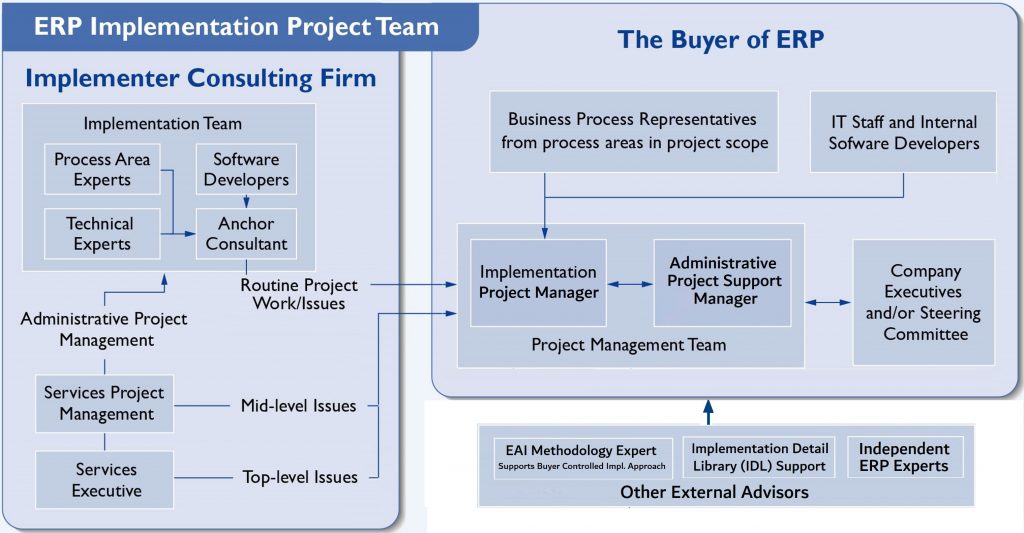
The ERP buyer's internal project management team is comprised of the two roles shown (Implementation Project Manager and Administrative Project Support Manager). The staffing model shows these two roles because the skills, company relationships, and capacity of each role are not usually found in one person, especially with larger and more complex projects. However, in some situations these roles can be combined for an appropriate individual to execute.
Implementation Project Manager: The ERP implementation control approach detailed in this document seeks to reach exceptional results, described as the ‘True project potential’ with modern ERP software well-suited for the ERP buyer’s business. Toward reaching these results, the following skills, experience, and capacity are necessary from the Implementation Project Manager.
- Experience with enterprise business software in general (with experience in the ERP being implemented a plus, but not necessary).
- Knowledge of business processes that will be affected by the new business software, including knowledge of best practices in various ERP project-related processes.
- Project management and change management skills.
- Experience with EAI implementation control methods and project management tools—or aptitude and attitude to quickly become trained and adapt.
- Being a skilled communicator. Effective style to productively work with all levels of people at the organization who will be using the new ERP.
- Flexible capacity of 20 to 50 hours per week to support the ERP implementation project.
- Proximity to the company’s ERP implementation project (to reduce travel costs and risks to arrive on site when depending on longer flights and connections), if a contractor is used.
Administrative Project Support Manager: ERP projects are subject to hundreds of large and small events and hundreds of actions, tasks and activities being planned and executed. Much of what keeps all of this moving forward is helping project team members be informed and accountable for their responsibilities. The purpose of the Administrative Project Support Manager role is to administratively help keep the overall project moving forward per plan. An existing company employee typically best fills this role. Helpful attributes for this role are:
- Known and respected by company members involved in the ERP project. Understands company politics and can navigate around potential obstacles.
- Excellent project management skills.
- Familiar with the business processes to be supported by the ERP—especially from an enterprise process flow level.
- Familiarity with the EAI implementation control methods which are typically introduced during ERP selection and during the pre-implementation readiness planning process.
- Ability to commit proper capacity to the ERP implementation project.
Support from Engleman Associates, Inc: The EAI implementation control methods and tools are a bit involved, as ERP projects are complex, subject to so many insidious dilution factors, and hold many large multi-dependency opportunities. One or more members of the EAI team work with the client and ERP implementer team as a coach in a consultative role and provides help with:
- EAI methods and tools–as tuned for an individual client’s ERP implementation project.
- Personnel issues with the ERP implementer or other contractors.
- ERP project scope increase requests, reviews, and discussions of merit, risks, and costs.
- ERP contract interpretation and defending the buyer’s interests.

Download the FREE ERP Implementation Risks Control White Paper
ERP Selection – Leupold & Stevens
Long term ERP license costs were initially very difficult to calculate. Working with SoftSelect we were able to insist on a predicable ERP license fee approach and achieve much lower initial and ongoing license fee costs.

ERP Selection – Cornell Pump
Negotiating ERP costs is complicated and the ERP software vendors take advantage of the buyer’s lack of experience. SoftSelect’s experience and influence helped us level the playing field. We clearly saved money and lowered our long term risk.

ERP Selection – Provo Craft
SoftSelect was a great partner throughout the process of choosing an ERP solution. They helped us control the terms throughout the ERP buying process, and we achieved impressive results in reduced ERP license fees. Having an experienced partner like SoftSelect, helped us negotiate for the products we need and set our expectations for the process of implementing these solutions.